
Fidium Blog

When planning home renovations, most homeowners focus on kitchens, bathrooms, decks, and curb appeal. But there's one critical infrastructure upgrade that's quietly becoming as important as a new roof or updated electrical system: high-speed fiber internet.
In today’s world, nearly everything we do is shaped by our ability to connect online. From students and professionals to retirees, connectivity drives daily life — and when that connection falls short, opportunity does too.
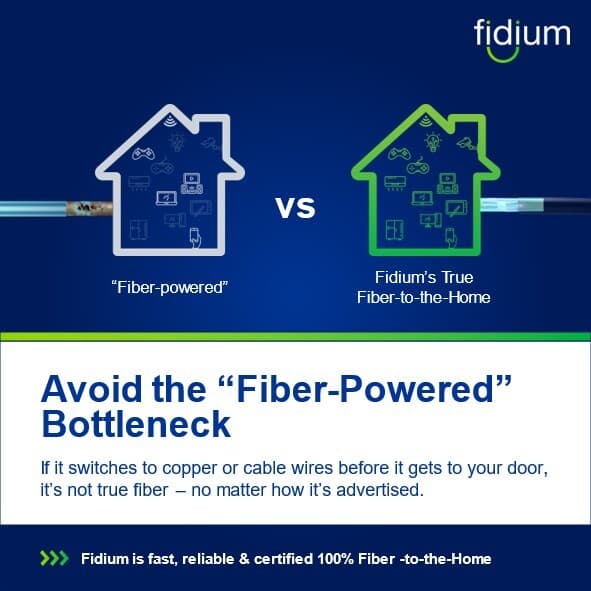
Marketing terms like “fiber-powered” and “100% fiber” can sound impressive — but they don’t always mean the same thing. Today, very different types of internet networks are often marketed using the word fiber, even though the technology behind them can vary greatly.
As enterprises modernize IT infrastructure, data center strategy is no longer defined solely by where servers are housed. It is defined by how efficiently, securely, and cost-effectively those environments connect to the network. Latency-sensitive applications, cloud adjacency, AI workloads, and multi-site architectures have made network connectivity the determining factor in colocation performance.
At Fidium Fiber, we see the AI decade as a turning point, where enterprise fiber must evolve from “fast enough” connectivity into a strategic platform for growth. With a fiber backbone spanning more than 67,000 route miles, access to 155+ on-net data centers, and a footprint reaching 250,000+ on-net and near-net buildings across 20+ states, we understand firsthand what modern enterprises require from their network as AI adoption accelerates.

Fidium's Sean Baillie shares how Artificial Intelligence (AI) is reshaping industries, unlocking efficiencies, and creating opportunities, but depends on a sophisticated ecosystem of infrastructure that includes GPUs, data centers, power and fiber networks.