
Fidium Hub
Branon Family Maple Orchards in Franklin County, Vermont has been producing maple syrup for six to seven generations - starting with horses, buckets, and wood-fired evaporators. Today, they tap 100,000 trees across 4,000 acres, produce 60,000 gallons of syrup, and do it all in just 30 days with a small family crew. What makes that kind of scale possible? Reliable connectivity. Fidium Fiber brought high-speed internet to the sugarhouse, giving the Branon family real-time monitoring across 30 cameras, eight remote pump stations, and miles of pipeline - all from their phones.
In today’s world, nearly everything we do is shaped by our ability to connect online. From students and professionals to retirees, connectivity drives daily life — and when that connection falls short, opportunity does too.
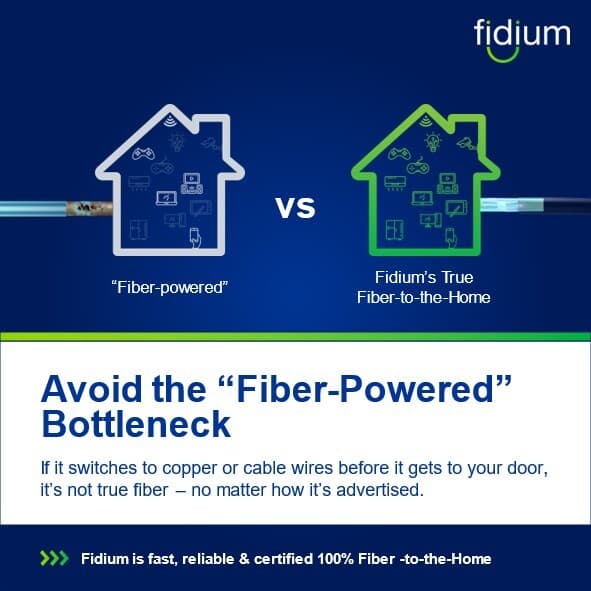
Marketing terms like “fiber-powered” and “100% fiber” can sound impressive — but they don’t always mean the same thing. Today, very different types of internet networks are often marketed using the word fiber, even though the technology behind them can vary greatly.
In household where a lot of different things happen at the same time, performance matters to Deborah and her family. While Deborah’s husband is working from home, her kids might be streaming a movie or online gaming. Read more about Deborah's experience with Fidium.
As enterprises modernize IT infrastructure, data center strategy is no longer defined solely by where servers are housed. It is defined by how efficiently, securely, and cost-effectively those environments connect to the network. Latency-sensitive applications, cloud adjacency, AI workloads, and multi-site architectures have made network connectivity the determining factor in colocation performance.
At Fidium Fiber, we see the AI decade as a turning point, where enterprise fiber must evolve from “fast enough” connectivity into a strategic platform for growth. With a fiber backbone spanning more than 67,000 route miles, access to 155+ on-net data centers, and a footprint reaching 250,000+ on-net and near-net buildings across 20+ states, we understand firsthand what modern enterprises require from their network as AI adoption accelerates.